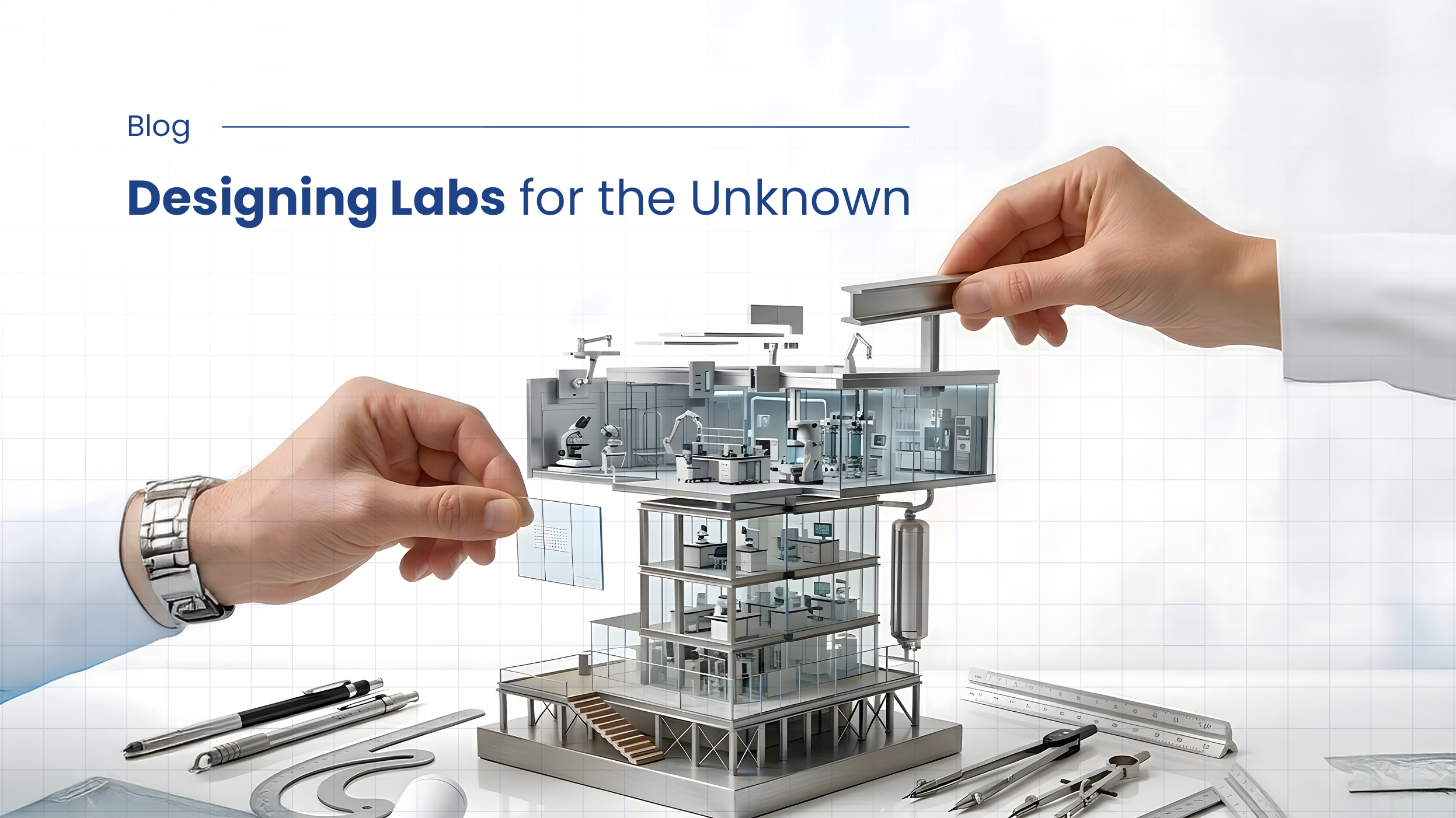
Scientific research rarely follows a predictable path. A discovery program can shift direction quickly. A team may begin with one set of experiments and, within months, move into entirely different methods or technologies. Yet many laboratories are still designed around fixed assumptions about how research will be conducted.
That works for a while. But science evolves faster than most buildings.
Designing research infrastructure today is less about creating the perfect lab for current experiments and more about building environments that can adapt as scientific work changes. The most effective laboratories are not rigid spaces built for one workflow. They are flexible platforms that can evolve with the science taking place inside them.
When Buildings Become Bottlenecks
In many research environments, the biggest constraints are not scientific ideas or talent. They are physical limitations of the building itself.
A new instrument may require higher electrical loads, different ventilation, or specialized exhaust systems. Installing it may mean opening ceilings, rerouting utilities, or redesigning the lab layout. What should be a simple upgrade becomes a lengthy infrastructure project. These delays affect productivity. Research timelines stretch, experiments are postponed, and teams spend time solving facility issues instead of scientific ones.
In fast moving research environments, even small delays can have a significant impact.
The Case for Flexible Lab Design
To address this challenge, modern research facilities are increasingly designed with flexibility at their core.
Rather than fixed layouts, laboratories are built using modular design principles. Bench systems can be rearranged as projects evolve. This approach recognises a simple reality. No one can fully predict the tools, methods, or research directions scientists will pursue five or ten years from now.
The scale of scientific activity also continues to expand. India alone produces roughly 2 million STEM graduates each year, creating a large pipeline of researchers entering academia, industry, and emerging technology fields. As scientific talent grows, the demand for research infrastructure grows alongside it.
Laboratories therefore need to support not only current work but future expansion as well.
The Role of Shared Scientific Infrastructure
Another important shift in research environments is the growth of multi-tenant scientific campuses.
In these settings, multiple research organisations operate within the same campus while maintaining their own independent laboratories and teams. Each company conducts its work independently, but benefits from access to high quality infrastructure that has been engineered specifically for scientific use.
This model allows research organisations to access sophisticated building systems and utilities without needing to construct them individually. As projects expand, teams can scale their laboratory footprint within the same ecosystem rather than relocating to new facilities.
The advantage is not just cost efficiency- It is continuity. Scientists remain within a stable research environment even as their programs grow.
Designing for Uncertainty
Perhaps the most important shift in research infrastructure is philosophical. Instead of designing laboratories for a fixed moment in time, infrastructure is now being planned around adaptability.
Scientific fields are evolving rapidly. New experimental techniques, data intensive research methods, and advanced instrumentation are redefining what laboratories require from their environments. Buildings that cannot adjust to the inherent flexibility of environmental changes quickly become outdated.
Flexible layouts, scalable utilities, and resilient building systems allow research environments to respond to this uncertainty. They create a framework where scientific work can evolve without constantly rebuilding the surrounding infrastructure.
The future of research facilities will not be defined by how precisely they meet today’s requirements. It will be defined by how well they support discoveries that have not yet been imagined.
In the end, designing laboratories for the unknown simply means accepting that science will always change. The best research environments are the ones that are designed to be accomodative and adaptive.
At Rx Propellant, we design and deliver purpose-built campuses that balance cutting-edge science with sustainability, flexibility, and future readiness. Our campuses are IFC EDGE Advanced and LEED Certified, underscoring our commitment to sustainable excellence. If you’re evaluating your next-generation R&D hub or manufacturing campus, let’s explore how our ESG-aligned infrastructure can drive long-term value.