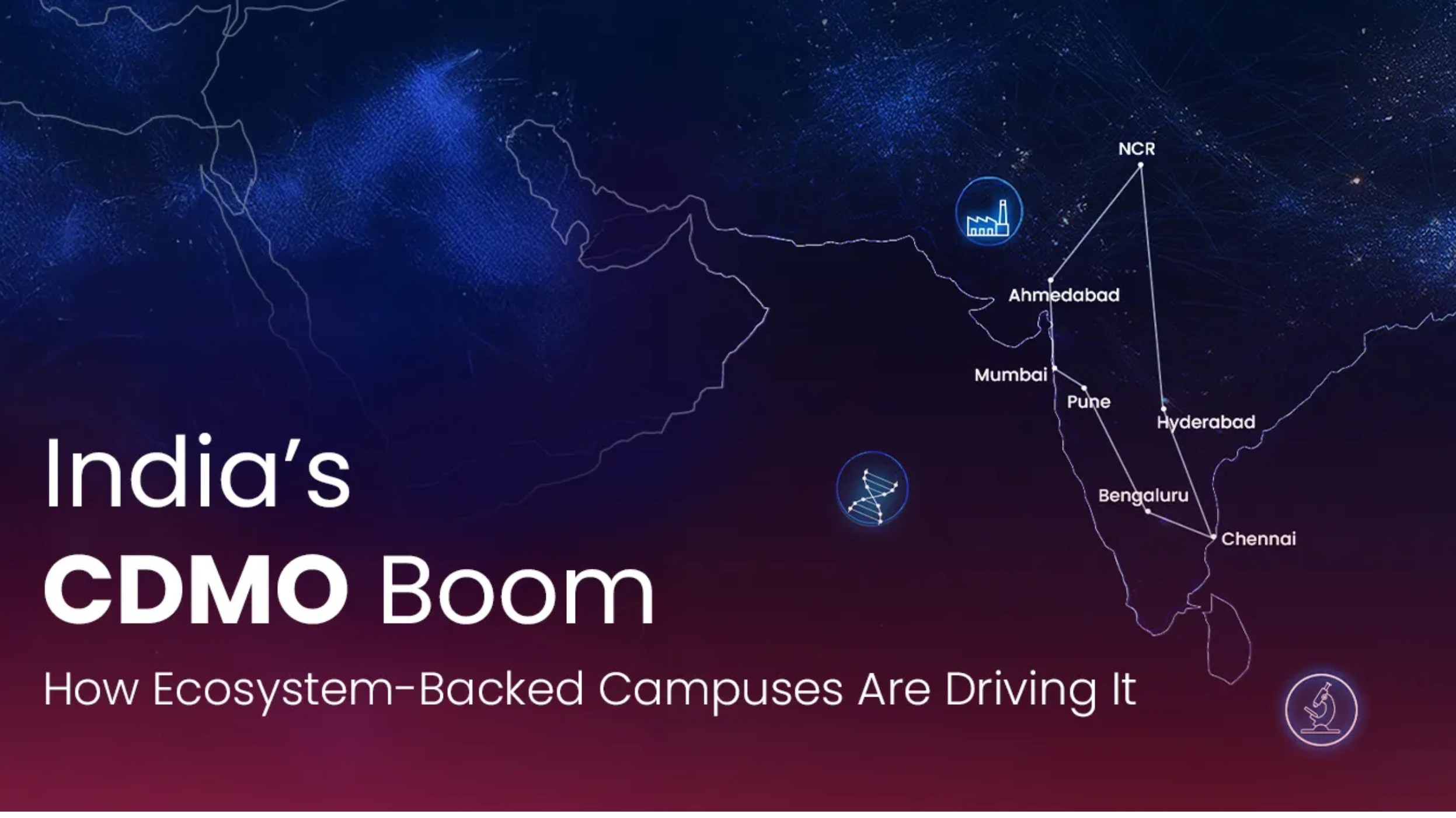
India stands at an inflection point in the global pharmaceutical industry. As multinational pharmaceutical companies diversify their supply chains, seek resilient manufacturing partners and accelerate outsourcing across research, development and manufacturing, India’s Contract Research, Development and Manufacturing Organisation (CRDMO) sector has emerged as one of the country’s most significant growth opportunities. The industry is expected to expand rapidly over the coming decade, requiring its scientific workforce to grow from approximately 50,000 today to well over 300,000 by 2035.
Much of the discussion around this opportunity has understandably centred on talent. India will need hundreds of thousands of additional scientists, engineers, process specialists and quality professionals to meet global demand. However, one equally important question receives far less attention. Where will these scientists carry out the next generation of pharmaceutical research and manufacturing?
Scientific talent cannot reach its full potential in isolation. Every breakthrough molecule, analytical method, manufacturing process and quality protocol depends on infrastructure that is purposefully designed for the science being performed. As India’s CRDMO industry evolves, the facilities that support it must evolve alongside it.
The next phase of growth demands a different kind of infrastructure
India built its pharmaceutical leadership on the strength of small molecule generics. The next phase of growth, however, is being driven by biologics, peptides, antibody drug conjugates, high potency APIs and increasingly digital and AI enabled research. These therapies require laboratories and manufacturing environments that are fundamentally different from conventional pharmaceutical facilities.
Advanced scientific work demands greater environmental control, more sophisticated utility systems, higher power redundancy, flexible laboratory layouts, specialised containment strategies and infrastructure that can support increasing levels of automation. These requirements cannot simply be accommodated through incremental modifications once a facility is operational. They must be considered from the earliest stages of planning and design.
This is why scientific infrastructure should not be viewed as conventional real estate. It is an operational asset that directly enables research, development and manufacturing capability.
Designing for tomorrow’s science
Scientific organizations are constantly evolving. Research priorities shift, technologies mature, regulatory expectations become more stringent and entirely new therapeutic modalities emerge. While scientific programmes may change every few years, campuses are expected to remain relevant for decades. This creates one of the most important challenges in life sciences infrastructure. Facilities cannot simply be designed for today’s requirements. They must be capable of supporting tomorrow’s science as well.
Future ready campuses are designed with flexibility at their core. Laboratories should be capable of adapting to changing research programmes. Utility infrastructure should accommodate future technologies without extensive reconstruction. Manufacturing spaces should allow organisations to introduce new processes and equipment as scientific priorities evolve. Expansion should be possible without disrupting ongoing operations. These decisions are rarely visible once a campus is complete, yet they often determine whether an organisation can respond quickly to changing market opportunities or finds itself constrained by its own infrastructure.
Infrastructure enables scientific capability
One of the most common misconceptions about life sciences facilities is that infrastructure is simply about buildings. In reality, infrastructure enables scientific capability. Automation illustrates this clearly. High throughput screening platforms, robotic sample handling, automated analytical systems and AI assisted research workflows can significantly improve consistency and productivity. However, these technologies also depend on reliable utilities, adequate power capacity, environmental stability, flexible service distribution and laboratories designed to accommodate increasingly sophisticated equipment. The same principle applies across biologics manufacturing, containment laboratories and advanced analytical facilities. Infrastructure does not create scientific excellence on its own, but it enables organisations to deploy the technologies and processes that do.
Lessons from China
China’s emergence as a global CRDMO powerhouse was driven by a combination of policy support, capital investment, talent development and manufacturing capability. Infrastructure alone did not create this success. What is instructive, however, is that scientific infrastructure evolved in parallel with scientific ambition. As research capabilities advanced and automation became more sophisticated, facilities were designed to support these changing requirements rather than forcing organisations to retrofit conventional industrial buildings for highly specialised scientific work. India has the advantage of learning from this evolution. As companies invest in advanced modalities and next generation manufacturing, they have the opportunity to build infrastructure that anticipates future scientific requirements rather than reacting to them later.
Campus strategy is becoming business strategy
Infrastructure decisions are increasingly strategic decisions. The location of a campus influences access to specialized talent, research institutions, suppliers and collaborators. The design of the campus determines how efficiently organizations can scale operations, integrate new technologies and respond to evolving customer requirements.
Similarly, the underlying engineering of a facility determines whether automation can be introduced efficiently, whether laboratories can be reconfigured without major disruption and whether new manufacturing capabilities can be added as the business grows. The campus is no longer simply where science takes place. It increasingly shapes what science an organization is capable of pursuing.
Building India’s next generation of scientific infrastructure
India’s CRDMO opportunity is real. The country possesses the scientific talent, entrepreneurial ecosystem and global credibility to become one of the world’s leading innovation and manufacturing destinations. Realizing that opportunity, however, requires more than expanding laboratory capacity. It requires campuses designed with flexibility, scalability and long term scientific relevance at their core. Facilities must be capable of accommodating changing modalities, supporting advanced automation and evolving alongside the organizations they serve. For life sciences leaders planning their next facility, infrastructure should not be viewed as the final step after business strategy has been defined. It should be recognized as one of the earliest strategic decisions because the capabilities built into a campus today will determine the science that can be delivered for years to come.
India’s next chapter in pharmaceuticals will undoubtedly be written by its scientists. The role of scientific infrastructure is to ensure those scientists have environments that enable them to innovate, collaborate and scale with confidence. The organizations that invest in both scientific capability and the infrastructure that supports it will be best positioned to define India’s place in the next generation of global pharmaceutical innovation.